
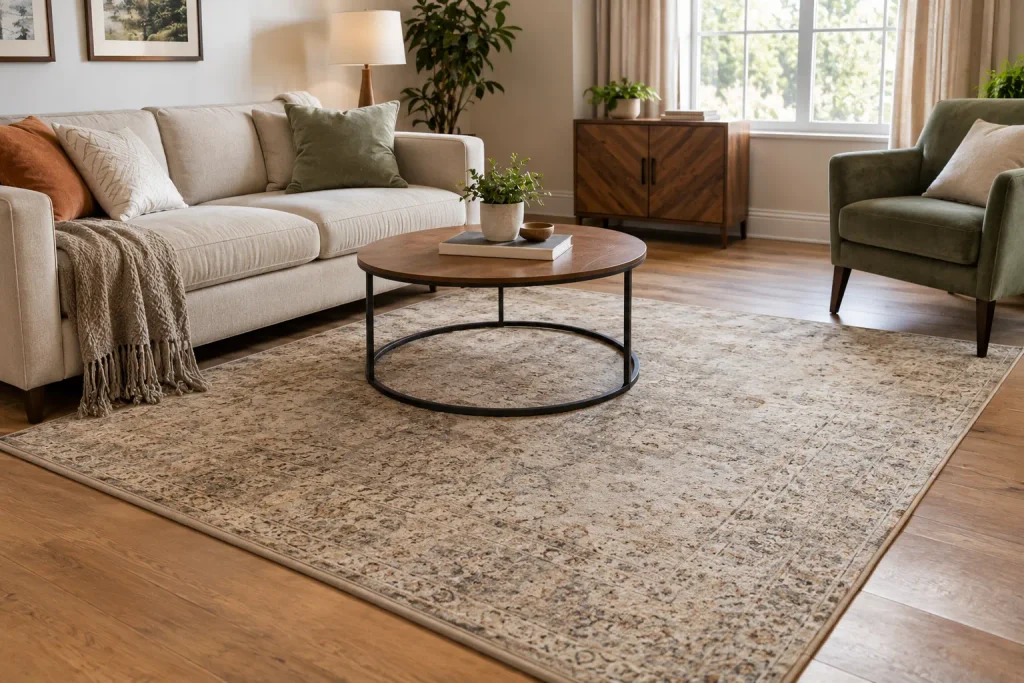
You found the perfect rug. The color is right, the texture is lovely, and it looked amazing online. Then it arrives, you unroll it, and it looks like a postage stamp floating in the middle of your living room.
If that has happened to you, you are in good company. Rug size is one of the most common things people get wrong when they decorate, and it is also one of the easiest to fix once you know a few simple rules.
This rug size guide covers the standard rug sizes you will find in stores, what size rug for living room layouts actually works, the right rug size for bedroom setups, and how to place a rug under furniture so the room looks pulled together. Grab a tape measure and let’s get into it.
Why Choosing Right Rug Size Matters More Than Style
Most of us pick rugs by color and pattern first, and size comes second. It should really be the other way around.
A rug that is too small chops a room into pieces. Furniture seems to drift away from the center, and the whole space feels smaller than it is. A rug that is too big can swallow the floor and make everything feel cramped. The right size ties your furniture into one comfortable zone and makes the room feel intentional.
This is why undersized rugs show up on our list of decor mistakes that make a home look cheap. The good news is that fixing it costs far less than replacing a sofa.
Standard Rug Sizes: The Quick Reference Chart
Rugs are sold in fairly consistent sizes, and most room layouts are built around them. Save or screenshot this chart.
| Rug Size (feet) | Inches | Best For |
| 2′ x 3′ | 24″ x 36″ | Doormats, sink areas, bedside accents |
| 3′ x 5′ | 36″ x 60″ | Entryways, small kitchens, in front of an armchair |
| 4′ x 6′ | 48″ x 72″ | Small entries, reading nooks |
| 5′ x 8′ | 60″ x 96″ | Small living rooms, twin beds |
| 6′ x 9′ | 72″ x 108″ | Apartment living rooms, full beds, small dining tables |
| 8′ x 10′ | 96″ x 120″ | Standard living rooms, queen beds, 6-seat dining tables |
| 9′ x 12′ | 108″ x 144″ | Large living rooms, king beds, 8-seat dining tables |
| 10′ x 14′ | 120″ x 168″ | Open-plan spaces |
| 2.5′ x 8′ | 30″ x 96″ | Hallway runners |
Round rugs usually come in 4′, 6′, 8′ and 10′ diameters. Many brands also sell slightly off sizes like 7’10” x 10′, so always check the exact measurements in the listing.
The Golden Rules of Rug Size guide
A few principles apply to almost every room.
Go bigger than you think you need. If you are stuck between two sizes, choose the larger one. A bigger rug usually looks more expensive and more balanced, and it makes the room feel larger.
Leave some bare floor. A rug should frame the room, not cover it wall to wall. Aim for about 12 to 24 inches of exposed floor in a large room and 6 to 12 inches in a small one.
Anchor the furniture. At the very least, the front legs of your main pieces should sit on the rug. This is what makes a seating area look connected.
Measure the zone, not the room. You are defining a seating area, a sleeping area or a dining area. Measure that zone first, then pick the rug.
Test it with tape. Mark the rug’s dimensions on your floor with painter’s tape and live with it for a day. You will know quickly whether it feels right.
What Rug Size is best for Living Room Layouts?
This is the question we hear most, and the honest answer is that it depends on how your furniture is arranged. Two layouts work in nearly every home.
All legs on the rug
This is the most polished look. Every piece in the seating group, including the sofa, chairs and coffee table, sits fully on the rug. It calls for a larger rug, usually 9′ x 12′ in a medium to large living room, or 8′ x 10′ in a more compact one. It works especially well in open-plan homes, where the rug marks the living area off from the dining space.
Front legs on the rug
This is the popular compromise. The front legs of the sofa and chairs rest on the rug while the back legs stay on bare floor, so the rug tucks about 6 to 10 inches under each piece. An 8′ x 10′ is the safe pick for most living rooms, and a 6′ x 9′ can work nicely in a smaller apartment.
What about a rug that only holds the coffee table? We would avoid it in most cases. It tends to look like an island, and only a very tight space with a 5′ x 8′ rug really justifies it.
A quick living room formula
Measure your sofa’s width and add about 12 to 18 inches on each side. For a typical 84-inch sofa, that points to a rug roughly 108 to 120 inches wide, which lands right in the 8′ x 10′ to 9′ x 12′ range. Keep at least 18 inches of bare floor between the rug and the walls in a large room, or 8 to 12 inches in a small one.
If you are styling the whole space from scratch, our guide to home decor ideas for every room and budget is a helpful companion, especially for matching your rug to everything else.
Rug Size Guide for Bedroom: Getting It Right Under the Bed
The bedroom is a little trickier because the bed takes up so much space. The goal is a soft landing spot for your feet when you get up, without a rug that looks awkwardly cut off.
The classic approach is to place the rug under the lower two-thirds of the bed, extending out on both sides and at the foot. Let it peek out at least 18 to 24 inches so your feet always land on something soft. In a small room, you can instead lay a smaller rug or runner across the foot of the bed.
| Bed Size | Mattress Width | Recommended Rug |
| Twin | 38″ | 5′ x 8′ |
| Full | 54″ | 6′ x 9′ or 5′ x 8′ |
| Queen | 60″ | 8′ x 10′ |
| King | 76″ | 9′ x 12′ (8′ x 10′ for a tighter look) |
| California King | 72″ | 9′ x 12′ |
A queen bed on an 8′ x 10′ rug, for example, leaves roughly 18 inches of rug showing on each side. That is the sweet spot for comfort and balance.
If your room is small, you do not have to skip a large rug. Try a 5′ x 8′ placed sideways under the foot of the bed, or use two runners, one on each side. Our small bedroom ideas that make your space feel bigger post has more layouts like this.
For warmth, choose a plush rug with a thicker pile. It pairs beautifully with the layered look in our cozy bedroom ideas, and if you want to see how a rug fits with bedding, lighting and storage, our bedroom decor ideas guide covers the whole room.
Dining Room Rug Size Guide
A dining rug has one practical job: when someone pulls out a chair and sits down, the chair legs should stay on the rug. If the back legs catch on the edge, the chair tips and scrapes.
The rule is simple. Measure your table and add at least 24 inches on every side. A 36″ x 72″ table needs a rug of at least 84″ x 120″, so an 8′ x 10′ works. A table that seats eight is better with a 9′ x 12′. For round tables, use a round or square rug, such as a 6′ round for a 36 to 44-inch table.
Low-pile or flat-weave rugs are far easier to live with here. Crumbs clean up easily and chairs slide smoothly.
Entryways, Hallways and Kitchens
Entryways. A 3′ x 5′ or 4′ x 6′ rug suits most entries. Make sure the door can swing open freely over it.
Hallways. Use a runner that leaves about 4 to 6 inches of bare floor on each side. A 2.5′ x 8′ runner fits most halls, and a longer one may need a 2.5′ x 10′.
Kitchens. A washable, low-profile runner with a non-slip backing works well in front of the sink or down a galley kitchen.
How to Place a Rug Under Furniture
Choosing the size is only half the job. Here is how to place a rug under furniture so the result looks deliberate.
Start with the biggest piece. Position the rug first, then move the sofa onto it. This is much easier than sliding a rug under heavy furniture.
Keep it straight. Use the walls, the sofa or a window as a guide. Even a small tilt makes the room look slightly off.
Be consistent with your legs. If the front legs of the sofa sit on the rug, do the same with the chairs. Mixing arrangements randomly looks messy.
Leave an even border. The bare floor visible around the rug should be roughly equal on all sides, which creates a calm, balanced frame.
Add a rug pad. A pad stops slipping, adds cushioning and protects your floor. Choose one about an inch smaller than the rug on every side so the edges lie flat.
Mind your walkways. Make sure the rug does not block doors or narrow paths. In high-traffic spots, a low pile won’t catch feet.
Layer when it helps. If you love a small patterned rug but need more scale, put a large neutral rug such as jute or flat-weave underneath first.
Shape, Pile and Material
Rectangular rugs are the default and suit most rooms. Round rugs soften a room with lots of sharp corners and work well under round tables or in reading nooks. As a rule, match the shape to your furniture arrangement.
High-pile rugs feel wonderful in bedrooms but can make furniture wobble and are harder to clean. Low-pile and flat-weave rugs suit dining rooms, hallways and busy living rooms. Wool is durable and hides dirt, cotton is easy to wash, and synthetics like polypropylene are budget-friendly and stain-resistant, which is handy for homes with kids or pets. Rugs have been woven by hand for thousands of years, and you can read more about that history on Wikipedia’s page on carpets and rugs.
Common Rug Size Mistakes to Avoid
- Buying too small. This is the big one. When in doubt, size up.
- Guessing instead of measuring. Measure twice, order once.
- Forgetting door clearance. A thick rug can stop a door from opening fully.
- Pushing the rug against the wall. Without a border of bare floor, the room feels crowded.
- Skipping the rug pad. Slippery rugs are annoying and can be a safety issue.
How to Measure Before You Buy
- Pick the zone. Seating, sleeping or dining.
- Measure the furniture that will sit in that zone.
- Add your margin, such as 24 inches around a dining table.
- Tape it out on the floor, walk around it and sit down to see how it feels.
- Adjust. Too small, go up a size. Too crowded, go down.
This ten-minute trick saves a lot of returns when you order online.
Frequently Asked Questions
What is the most popular rug size?
The 8′ x 10′ is the most common, since it suits a standard living room and a queen bed.
Is a 5′ x 8′ rug big enough for a living room?
Only in a small room or tight apartment. Most living rooms look better with 8′ x 10′ or larger.
How far should a rug extend past the sofa?
About 12 to 18 inches on each side is a good target.
Can I use two rugs in one room?
Yes. In large or open-plan rooms, separate rugs can define different zones. Keep the colors and styles related so the room still feels cohesive.
Final Thoughts
Choosing the right rug size does not need to be complicated. Measure your zone, lean toward the larger size when unsure, keep your furniture legs consistent, leave some bare floor around the edges and use a pad to hold everything in place.
Whether you are working out what size rug for living room comfort, the right rug size for bedroom layouts, or just trying to make sense of standard rug sizes, you now have a clear plan. Save the chart, grab the painter’s tape and enjoy the moment the rug finally looks like it was meant to be there.
Have a rug question we did not cover? Leave a comment below and we will help you work it out.
Pingback: How to Style a Coffee Table: Step-by-Step Looks That Work